Function Classification and Detailed Explanation of IEPE Type Motor Operating Condition Sensors
I. Core Function Positioning
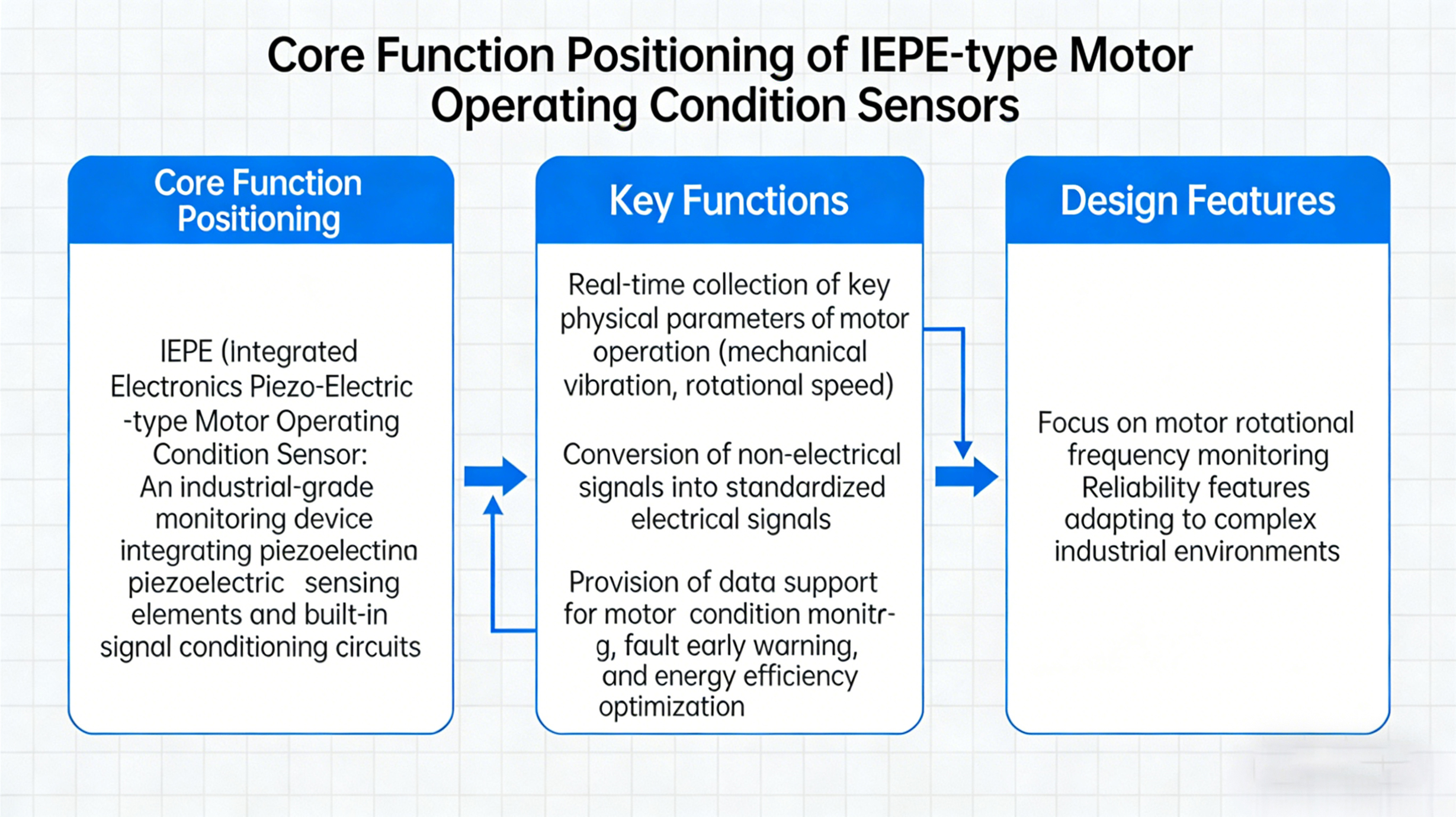
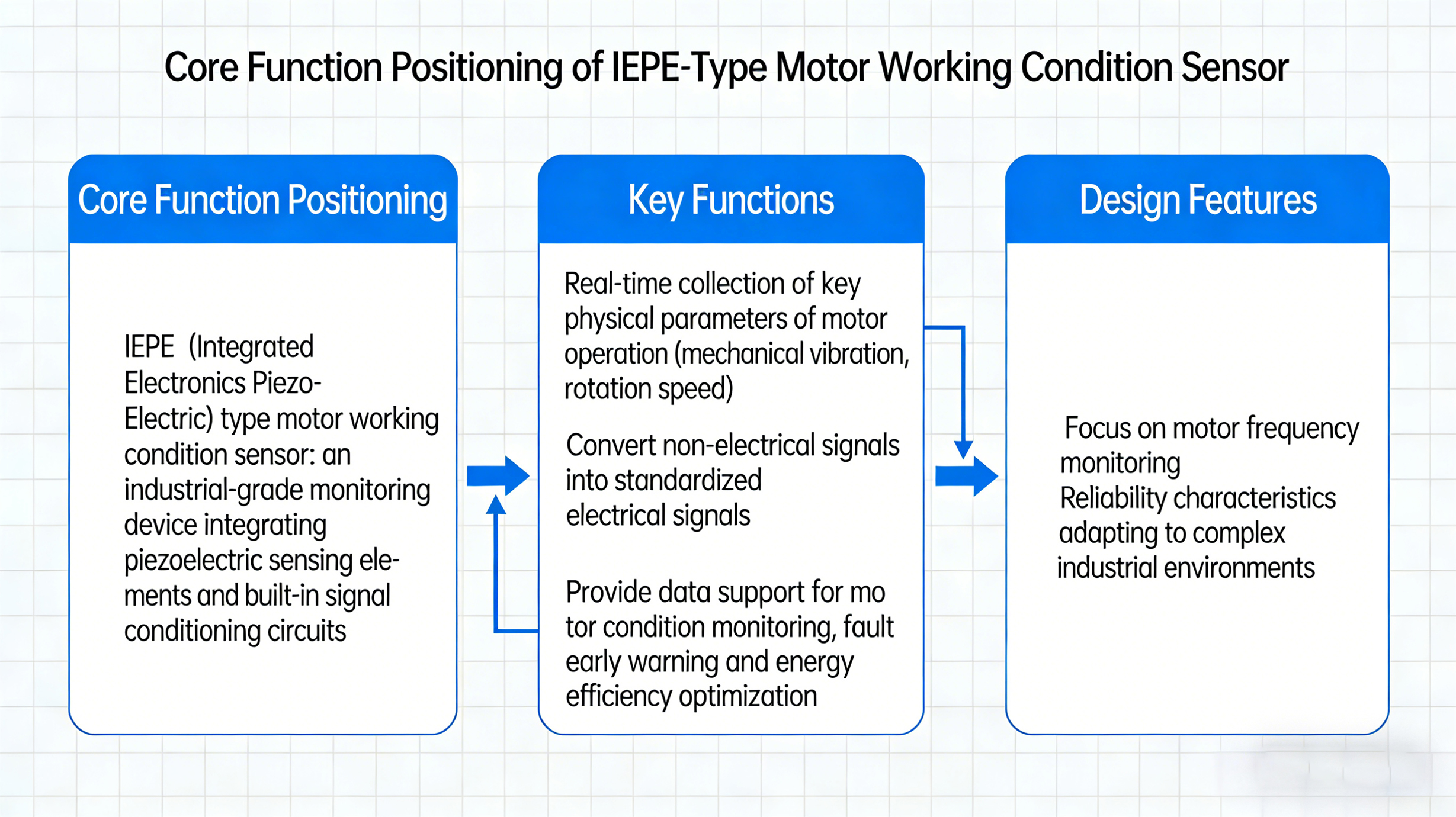
The IEPE type motor operating condition sensor is an industrial-grade monitoring device that integrates a piezoelectric sensing element with an internal signal conditioning circuit. Its core function is to continuously collect key physical parameters during the motor's operation. By converting non-electrical signals such as mechanical vibration and rotational speed into standardized electrical signals, it provides data support for motor condition monitoring, fault prediction, and energy efficiency optimization. The design focuses on monitoring the motor's rotational frequency, while also possessing the reliability characteristics suitable for complex industrial environments.
II. Detailed Explanation of Key Technical Characteristics and Functions
1. IEPE technical architecture: High-precision signal acquisition and processing
Principle: Utilizing the piezoelectric effect principle, the sensor's built-in piezoelectric crystals generate charge signals when the motor vibrates or rotates. These signals are converted into low-impedance voltage signals (typically 4-20mA or 0-10V standard output) by the integrated microelectronic circuits (including charge amplifiers, filtering circuits, and temperature compensation modules), which are directly compatible with industrial control systems (such as PLC, DCS).
Advantages: Compared to traditional piezoelectric sensors, it eliminates the need for external signal conditioning equipment, simplifying system integration; the built-in circuits achieve signal amplification and noise suppression, improving measurement accuracy (frequency measurement error typically ≤ ±0.1%); supports a wide dynamic range (such as frequency monitoring range of 0-10000Hz), covering low-speed to high-speed motor scenarios.
2. High insulation and withstand voltage design: Ensuring motor operation safety
Insulation performance: The sensor's housing and internal circuits use reinforced insulation materials (such as polytetrafluoroethylene, ceramics), with an insulation resistance of ≥ 1000MΩ (500VDC conditions), capable of withstanding high-frequency electromagnetic interference and leakage risks during motor operation, avoiding the sensor becoming a circuit safety hazard.
Withstand voltage capability: It has high voltage isolation characteristics, capable of withstanding AC 2500V and above surge voltages, suitable for voltage fluctuations in industrial power supply systems with intense fluctuations (such as motor start-up, stop, etc.), preventing sudden high voltages from damaging the sensor's core components.
3. Surge protection design: Adapting to harsh power grid environments
Circuit protection mechanism: Built-in TVS (Transient Voltage Suppression) diodes and voltage-sensitive resistors can clamp overvoltage within nanoseconds when the motor power supply system experiences lightning strikes, grid fluctuations, etc., protecting the sensor's internal integrated circuits (IC) and piezoelectric elements from damage.
Application scenarios: Particularly suitable for industrial power grids with unstable conditions (such as mining, metallurgical motors), or motors that need to be installed outdoors (such as wind power, water pump motors), reducing the risk of sensor failure due to surges.
4. Overall sealing structure: Strengthening environmental adaptability
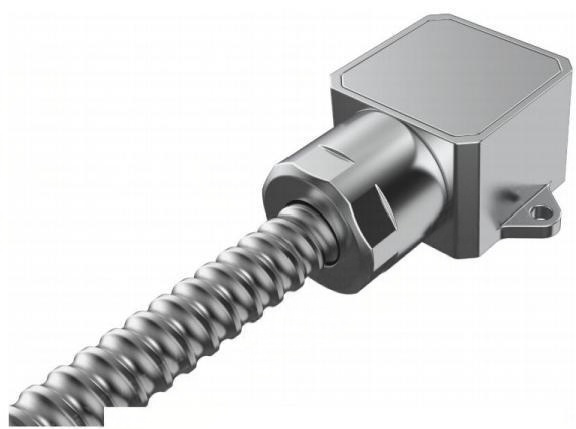
Protection level: Using a full-metal casing (such as stainless steel 316L) and laser welding sealing technology, the protection level reaches IP67/IP68, capable of completely preventing dust intrusion and short-term immersion (1 meter water depth for 30 minutes), suitable for humid, oily, dusty motor installation environments (such as paper mills, automotive production lines motors).
Temperature adaptability range: Through wide-temperature design (-40℃~+120℃), it can work stably in extreme temperature conditions, avoiding measurement drift caused by environmental temperature changes (temperature drift coefficient ≤ 0.01%/℃).
5. Full specification motor frequency monitoring: Universality and compatibility
Frequency measurement method: Supports two installation methods - non-contact (through detecting the motor shaft end reflective marks or gear tooth tops) and contact (through coupling connecting the motor shaft), suitable for various motor types such as asynchronous, synchronous, and servo motors.
Specification coverage range: Can monitor frequency ranges from 0.1Hz (low-speed motors, such as mixing motors) to 10kHz (high-speed motors, such as spindle motors), meeting the frequency monitoring requirements for miniature motors (power < 1kW) to large industrial motors (power > 1000kW), without the need to change sensor models based on motor specifications.
III. Functional Synergy and Application Value
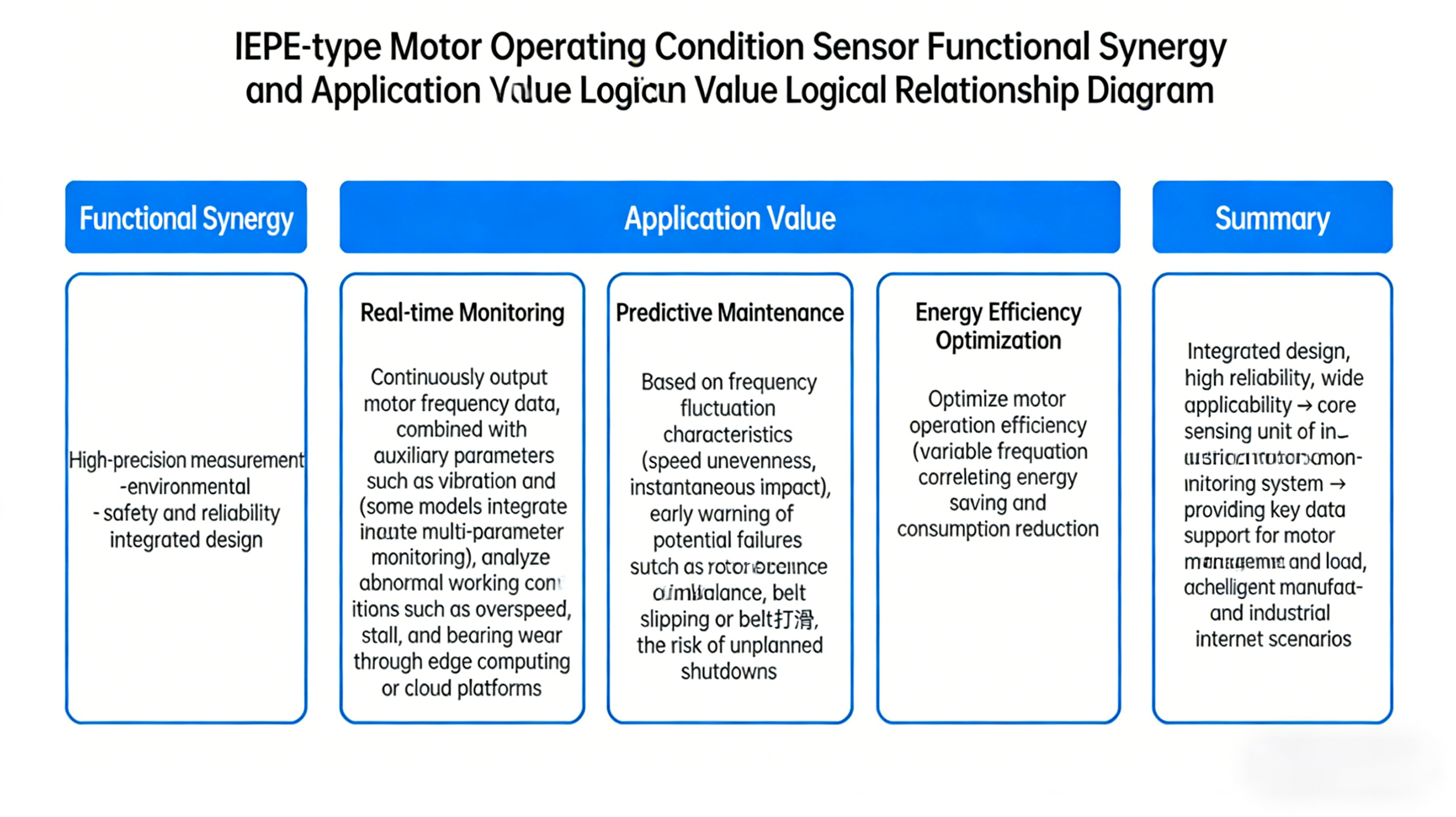
The IEPE type motor condition sensor achieves an integrated design of "high-precision measurement - environmental adaptability - safety and reliability" through the synergy of the above technical characteristics:
Real-time monitoring: Continuously outputs motor rotation frequency data, combined with auxiliary parameters such as vibration and temperature (some models integrate multi-parameter monitoring), and can analyze whether the motor has abnormal conditions such as overspeed, stall, or bearing wear through edge computing or cloud platforms.
Predictive maintenance: Based on the fluctuation characteristics of rotation frequency (such as uneven rotational speed, instantaneous impact), it provides early warnings for potential faults (such as rotor imbalance, belt slipping), reducing the risk of unplanned downtime.
Energy efficiency optimization: Through the correlation analysis of rotation frequency and load, it optimizes the operating efficiency of the motor (such as variable frequency speed control), achieving energy conservation and cost reduction.
In summary, the IEPE type motor condition sensor, with its integrated design, high reliability, and wide applicability, has become the core sensing unit in the industrial motor condition monitoring system, providing key data support for motor health management in intelligent manufacturing and industrial internet scenarios.
Main parameters
| Parameter | Indicator |
|---|
| Sensitivity | 500mV/mT |
| Range | ±10mT |
| Output bias voltage | 10.5~13.5VDC (typical value: 12VDC) |
| Constant current | 2-20mA (typical value: 4mA) |
| Excitation voltage | 18-30VDC (typical value: 24V) |
| Protection grade | IP68 |
| Shell material | 304 stainless steel |
| Output method | M12 aviation connector |
Product Application
It is used for monitoring the motors of industrial rotating machinery, capable of analyzing the current trend of the motor, the trend of speed changes, identifying start-stop operations, load conditions, etc.