Explosion-proof type and explosion-proof mark
Explosion-proof type: Mine intrinsically safe type; Explosion-proof mark: "Ex ib I Mb"
Main electrical performance
The main electrical performance of the intrinsically safe walkie-talkie for mining is the key guarantee for its safe and reliable operation in explosive hazardous environments such as coal mines. Specifically, it includes:
Operating voltage and current
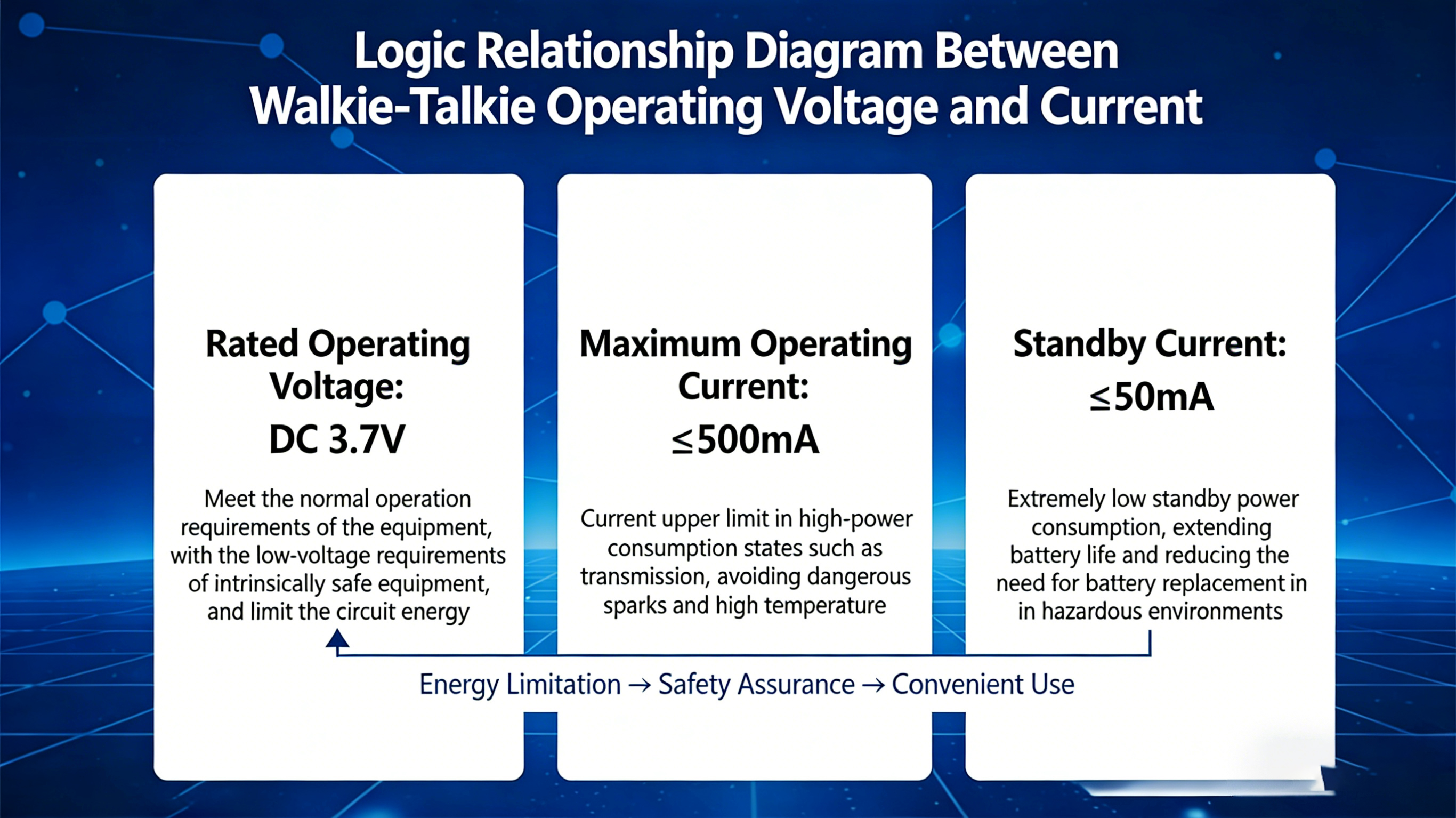
The rated operating voltage of this walkie-talkie is DC 3.7V. This voltage design not only meets the normal operation requirements of the equipment but also complies with the basic requirements for safety equipment regarding low voltage. It helps to limit the energy in the circuit. The maximum operating current is ≤ 500mA. This parameter reflects the upper limit of current during the device's high-power operating states such as transmission, ensuring that no dangerous sparks or excessive temperatures will be generated due to excessive current. The standby current is ≤ 50mA. The extremely low standby power consumption is conducive to extending the battery's usage time, reducing the need to frequently replace batteries in hazardous environments, and enhancing the convenience and safety of use.
Battery parameters
a) The battery type selected is a single cell lithium-ion manganese oxide battery. Manganese oxide lithium batteries have a high energy density and good discharge performance, which can provide stable power support for the walkie-talkie. Additionally, their chemical properties are relatively stable, making them suitable for use in intrinsically safe equipment.
b) The battery model is PL123450. This model is a specific identifier for the battery, including information such as the size and shape of the battery, facilitating accurate matching during replacement and maintenance.
c) The battery specifications are 3.7V/1.6Ah. Here, 3.7V is the nominal voltage of the battery, matching the rated working voltage of the walkie-talkie; 1.6Ah represents the capacity of the battery, meaning that at a current of 1.6A, it can maintain a discharge for 1 hour. This directly affects the battery's endurance.
The maximum open-circuit voltage of the battery is DC 4.2V. This is the maximum voltage value of the battery when fully charged. When designing the circuit, the influence of this voltage on related components must be considered to ensure that the equipment can still work safely at the highest voltage.
The maximum short-circuit current of the battery is ≤ 2A. In intrinsically safe equipment, even in the extreme case of battery short-circuit, the short-circuit current must be limited within a safe range to prevent the generation of sparks or heat sufficient to ignite explosive gases. This parameter strictly controls the short-circuit risk.
d) The continuous standby time is not less than 8 hours. This means that after being fully charged, the walkie-talkie can maintain a standby state for at least 8 hours without making calls or other operations, meeting the requirements for long-term standby of equipment in environments such as coal mines.
Wireless transmission parameters
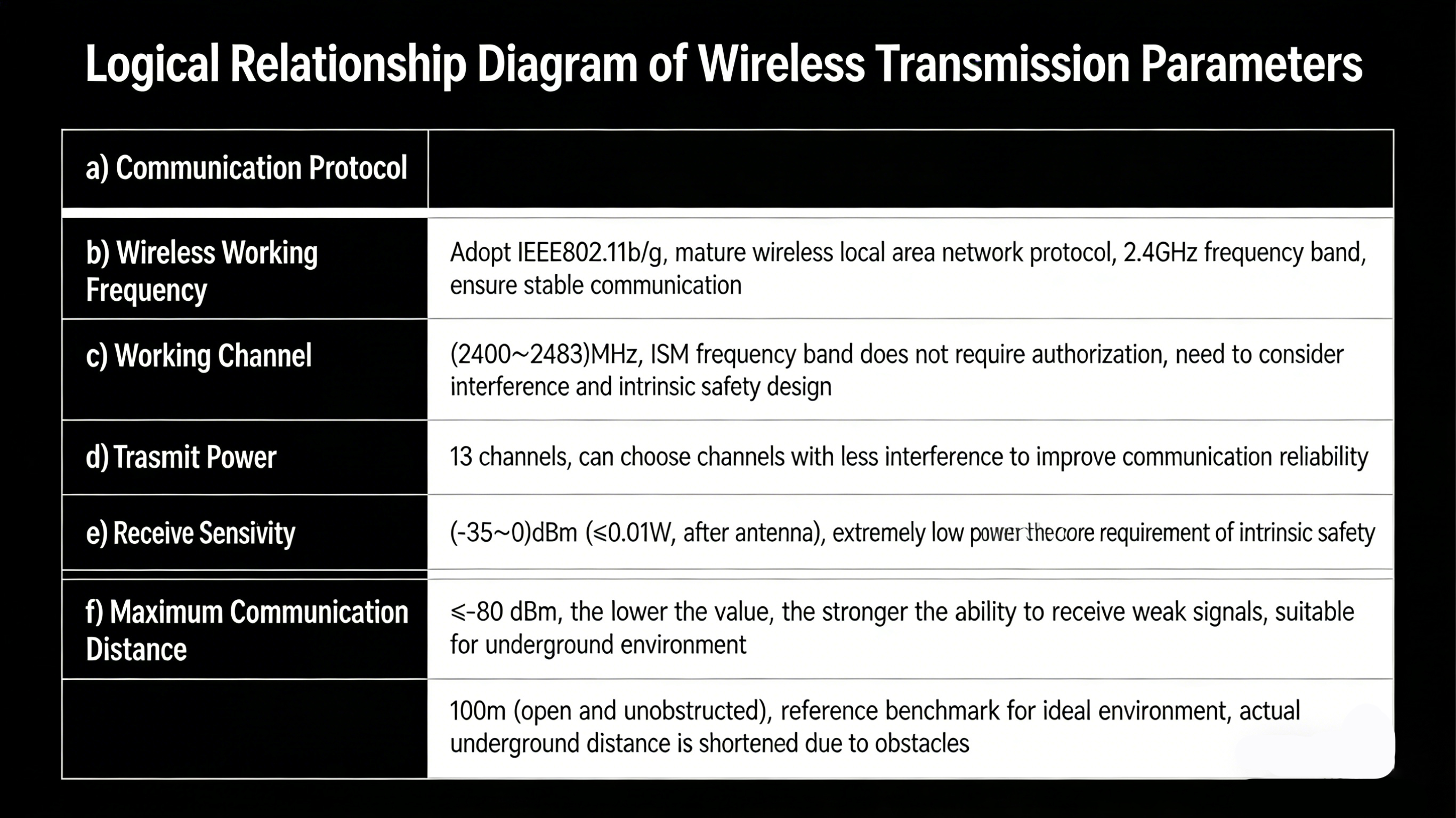
a) The communication protocol adopts IEEE802.11b/g, which is a mature wireless local area network protocol. It supports data transmission in the 2.4GHz frequency band and can ensure stable communication between walkie-talkies or with other network devices.
b) The wireless working frequency is (2400~2483) MHz. This frequency band belongs to the Industrial, Scientific and Medical (ISM) band and can be used without authorization. However, the selection of the frequency range needs to consider interference with other wireless devices and the requirements of safety design.
c) The working channels are 13 channels. The setting of multiple channels enables users to choose the less interfered channels for communication according to the actual environment, improving the reliability and stability of communication.
d) The transmission power is (-35~0) dBm (not exceeding 0.01W, after the antenna), the extremely low transmission power is one of the core requirements of the safety design, effectively limiting the energy generated during wireless transmission and ensuring that it will not ignite the surrounding explosive gas mixtures.
e) The receiving sensitivity is ≤ -80 dBm, the receiving sensitivity reflects the ability of the walkie-talkie to receive weak signals. The lower this value, the weaker the signal that the walkie-talkie can receive, thus ensuring good reception effect in complex underground environments.
f) The maximum communication distance is 100m (in an open and obstacle-free environment). This parameter indicates that in an ideal open environment, the walkie-talkie can achieve effective communication within a 100-meter range. In actual underground environments, due to the presence of tunnels, equipment, etc., the communication distance may be shortened, but this indicator provides a reference benchmark for users.
Ringing loudness
The ringing loudness is ≥ 75dB(A). In a noisy coal mine environment, sufficient ringing loudness ensures that users can clearly hear the call signal, avoiding missing important information due to too small ringing sound, and ensuring the timeliness and effectiveness of communication.
Main functions
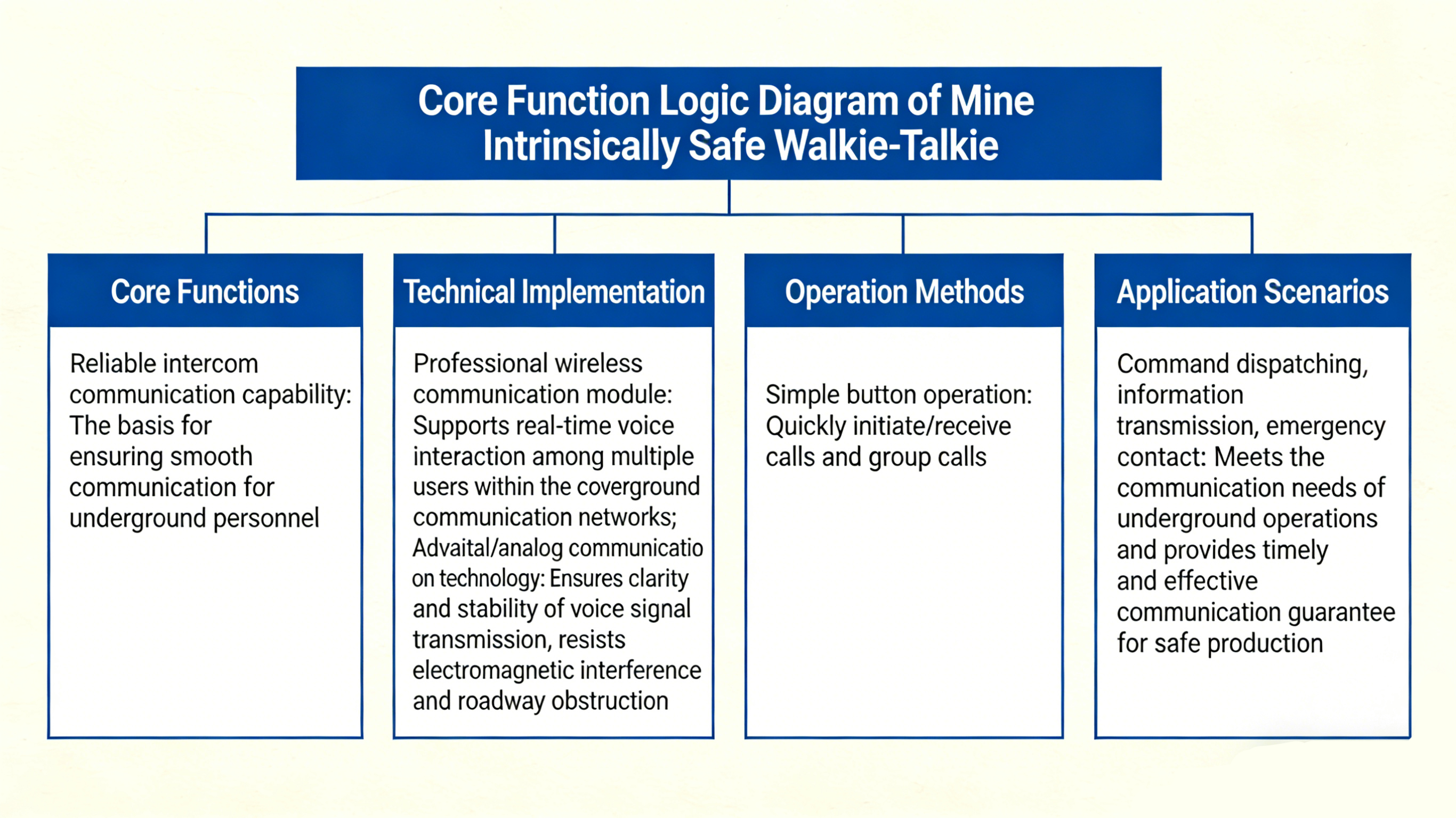
The core function of the mine-safe two-way radio lies in its reliable communication capability, which is the foundation for ensuring smooth communication among personnel in complex underground environments such as coal mines. This function is achieved through professional wireless communication modules and supports real-time voice interaction among multiple users within the specific communication network coverage in the underground. It adopts advanced digital or analog communication technologies to ensure the clarity and stability of the voice signal during transmission, even in the presence of electromagnetic interference, tunnel obstructions, and other complex conditions, ensuring the quality of the communication. Users can quickly initiate calls, answer calls, and conduct group calls through simple button operations, meeting various communication needs such as command and dispatch, information transmission, and emergency contact in underground operations, providing immediate and effective communication guarantees for safe production.
Appearance and structure
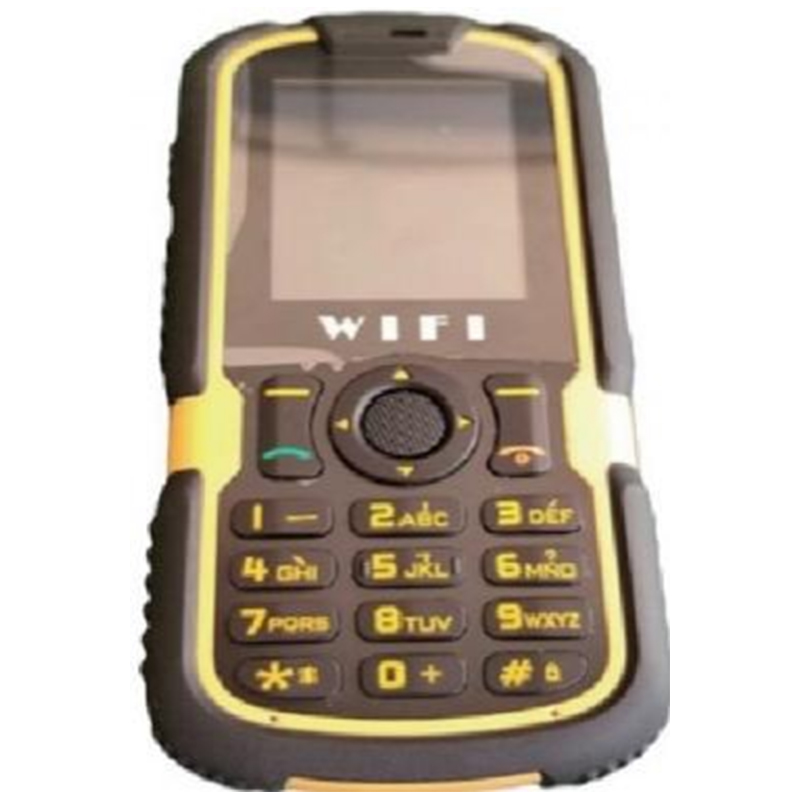
The appearance and structure of the mine-safe two-way radio have been designed to fully consider the special requirements of complex and dangerous environments such as coal mines. While ensuring safety performance, it also takes into account the convenience of operation and the comfort of carrying.
The shell material is selected as ABS plastic. ABS plastic has excellent comprehensive properties. Firstly, it has high impact strength and surface hardness, which can effectively resist possible collisions and friction in underground operations, protecting the internal precision electronic components from damage; Secondly, ABS plastic has good chemical corrosion resistance, which can adapt to the possible dampness, dust, and certain corrosive gas environments in the underground; Moreover, this material also has certain insulation properties, which is helpful for reducing static electricity generation and preventing leakage, meeting the requirements of intrinsic safety and ensuring the safety of use in potential explosive gas environments.
The protection level of the shell reaches IP65. Here, "IP" is the abbreviation of Ingress Protection, representing ingress protection level. The first digit "6" indicates that the radio's shell can completely prevent dust from entering, even in the high-dust environment of coal mine underground, effectively blocking dust from entering the equipment interior and avoiding damage to the equipment due to dust accumulation. The second digit "5" means that it can withstand low-pressure water jets from any direction, such as water splashing or dripping in the underground, and the equipment interior will not be waterlogged, ensuring the stable operation of the equipment in a humid environment, further enhancing its reliability in harsh conditions.
The overall size of the radio is 125.5mm × 61mm × 25mm. This design makes the radio present a relatively compact rectangular shape, with a length of approximately 12.5 centimeters, a width of approximately 6.1 centimeters, and a thickness of approximately 2.5 centimeters. Such a size is convenient for operators to hold with one hand, and the button layout and operation interface can be designed relatively reasonably, facilitating operation with gloves on. At the same time, the compact size also makes it easy to carry it around the waist or place it in a pocket, without causing excessive interference to the normal operations of underground workers.
The weight is approximately 130g. The lightweight design is one of the important features of the mine-safe two-way radio. A weight of around 130 grams is equivalent to that of a regular mobile phone, significantly reducing the fatigue of operators when carrying for a long time. During long-term underground operations, the weight of the equipment will directly affect the comfort and flexibility of workers' operations and activities. A lighter weight enables workers to carry and use the radio more easily, ensuring smooth communication without adding additional physical burdens.
In conclusion, the appearance and structure of the mine-safe two-way radio are closely centered around the safety operation requirements of coal mine underground environments, striving to provide a practical, convenient, and comfortable user experience while ensuring intrinsic safety.